Rachel Gain
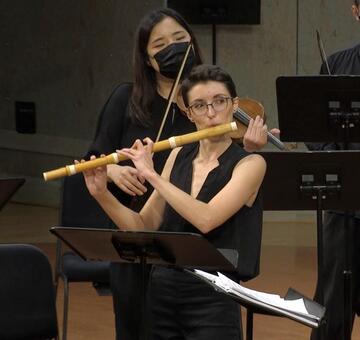
Rachel Gain is a Music Theory Ph.D. candidate in the Yale Department of Music. Their dissertation examines contemporary rhythm tap dance improvisation, including its musical and physical syntaxes, notation, expressive meanings, embodied epistemologies, and the myriad implications of the body’s role as an instrument. The project provides a holistic model for understanding and studying tap as jazz music that is attuned to practitioners’ understandings of their art form and acknowledges rhythm tap’s physical, visual, and cultural systems of meaning-making. Beyond the dissertation’s focus, Rachel’s scholarly investments in tap are wide-ranging, spanning issues of raced, gendered, and classed identity; the archive; jazz historiography; pedagogy; genre; and epistemology. As part of this research, they regularly take tap classes in New York City and attend rhythm tap festivals across the US. Rachel has several forthcoming publications from this work, including a chapter in the Oxford Handbook of Vaudeville.
Outside of jazz tap, Rachel has expertise in instrumental music from the early-eighteenth and early-twentieth centuries, especially J.S. Bach, French baroque chamber music, historically informed performance practice, Paul Hindemith, and Gustav Holst’s music for schoolgirls. Held in common across these interests is the approach of analyzing and theorizing through the performer’s body and instruments, and engaging with ecologies, interfaces, embodiment, and agency in a socially and historically contextualized manner. More generally, their work demonstrates a commitment to epistemological reflexivity; interrogating the methodologies, aims, and ethics of research; and building a “better” music theory.
In 2022, Rachel’s paper Beyond the Audible: Embodied Choreographic Syncopations in Rhythm Tap Dance won the SMT Student Presentation Award and received an Honorable Mention for Music Theory Midwest’s Komar Award. They have presented their research at conferences including the American Musicological Society, Society for Music Theory, Society for American Music, Dance Studies Association, various regional and international music theory societies, and specialist conferences such as Theorizing African American Music, the North American British Music Studies Association, and the Historical Performance Institute. Invited presentations include the Society for Music Analysis Zoom Colloquium and Florida International University’s Green Library Listening Closely lecture series.
Rachel holds an MPhil and MA in Music from Yale, an MA in Music Theory from the University of Western Ontario (Canada), a first-class BMus (Hons) from the University of Birmingham (UK), and an ATCL in flute performance (UK). Prior to joining Yale, they studied at the University of North Texas, where they completed doctoral coursework in Music Theory and Early Music, and served as President and Vice-President of the Graduate Association of Musicologists und Theorists (GAMuT). At UNT, they founded and chaired GAMuT’s symposium series and co-chaired the 8th and 9th annual graduate student conferences.
A passionate pedagogue, Rachel has extensive teaching experience, including as instructor of record for MUSI 210 Counterpoint, Harmony, and Form: 1500–1800 and MUSI 110 Elements of Musical Pitch and Time at Yale and for Aural Skills I–IV at UNT. Combining research and pedagogy, Rachel regularly shares their work on tap with graduate and undergraduate classes at other institutions. They have also taught musical instruments to students ranging from toddlers to music majors to elders, and take joy in sharing their music theory and tap knowledge both formally and informally.
Rachel dedicates much of their spare time to academic service. They currently serve as co-chair of the AMS Music and Dance Study Group, co-chair of the SMT Dance and Movement Interest Group, and student representative for the SMT Committee on Feminist Issues and Gender Equity. In 2024, with Dr. Christopher M. Scheer, they organized the symposium “Rethinking Gustav Holst and his Music” at Utah State University to celebrate Holst’s sesquicentennial, which will culminate in an edited volume.
At Yale, they are involved in various initiatives. In the Department of Music, they serve on the Professional Development Panel and coordinate the Guest Speaker Series. They serve as Musical Director, Graduate Student Coordinator, and Historian of Taps at Yale and regularly perform and choreograph with the group. During their summers, Rachel teaches tap history/improvisation and pop music composition to New Haven high schoolers through Yale’s Pathways to the Arts & Humanities program. In addition to making music with their tap shoes, they have performed on the baroque flute with Yale’s Institute of Sacred Music, Collegium Musicum, and Community Baroque Band and on various combinations of flute(s), clarinet, and saxophone(s) in campus musical theater productions, most recently Fun Home.
Outside of academics, academic service, and academized hobbies, Rachel is a proud dog-dad to two rescue pit bulls, an occasional enjoyer of New England contra dance, an unreasonably fast walker, and a keen indoor boulderer.